Dr. Laura Figulla
CEO & Co-Founder
15+ years in life science venture building, corporate finance and strategy. Co-founder and former CEO of Coramaze Technologies (TMVR) and mbiomics.
LinkedIn
One transcatheter aortic valve (TAVR) platform in two configurations: without drug delivery, designed for aortic regurgitation, and with an antibiotic-eluting skirt, designed for infective endocarditis.
TAVR has become the standard of care for aortic stenosis, depending on age, anatomy and surgical risk of the patient. Conventional TAVR systems anchor against the calcified annulus. In aortic regurgitation there is no calcium, so anchoring becomes a major challenge. The first dedicated transcatheter AR valve was recently approved, but one significant AR patient segment, infective endocarditis, still has no transcatheter option.
Standard therapy for infective endocarditis requires four to six weeks of systemic antibiotics, yet falls short: antibiotics alone cannot reverse the aortic valve destruction, and many high-risk patients are denied surgery.
devie medical is developing a drug-eluting TAVR platform designed for exactly this anatomy and pathology. Our founders have built and commercialized structural heart companies before; devie carries that design heritage into a new category.
The largest segment. A non-calcified annulus makes conventional TAVR unreliable; the first dedicated AR valve was FDA-approved only in 2026.
Emergency presentation, often with cardiogenic shock. No dedicated transcatheter option, and surgery is frequently too high-risk.
About 45,000 cases a year in the US, 30,000 on the aortic valve. With Staphylococcus aureus, 28% die in hospital and 42% within a year; 20–40% suffer embolic stroke or cerebral ischemia.
Early prosthetic valve endocarditis carries reported mortality above 70%. No commercial valve offers preventive technology.
Sources: Chen et al., Front Med 2022 (GBD 2019); Cahill et al., JACC 2017; Østergaard et al., J Am Heart Assoc 2022; Eur Heart J 2019; Figulla HR, Cardiovasc Revasc Med 2023;57:16–17; Lauten A et al., Clin Res Cardiol 2021;110:323–331; Figulla HR, Seidel RA, Lauten A, Infective endocarditis and evolving transcatheter treatment options, in: Transcatheter Aortic Valve Implantation, 2nd ed., CRC Press 2024:269–272; Figulla HR, Webb JG, Lauten A, Feldman T, Eur Heart J 2016;37:2226–2239.
From the TAVR landscape to the unmet need in infective endocarditis and how the drug-eluting devie valve is designed to work.
Schematic animation with captions · 3:10 · Investigational device, not available for sale.
By combining mechanical containment and local drug delivery with systemic therapy, devie aims to provide a new transcatheter treatment approach: the drug-eluting TAVR valve. The antibiotic-eluting skirt is a module, not a redesign.
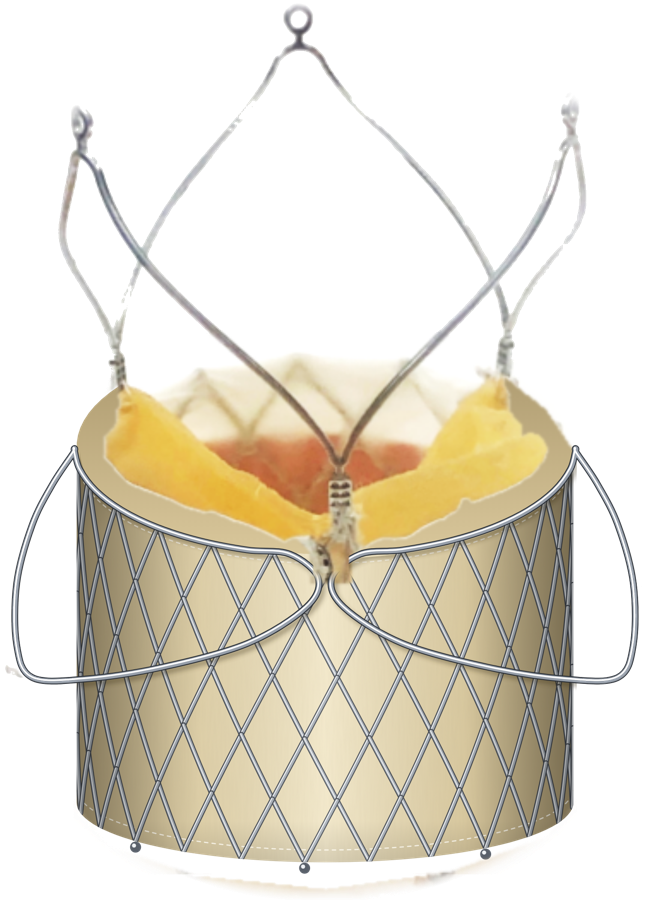
Designed for aortic regurgitation: a self-expanding frame for chronic and acute AR with calcium-independent anchoring.
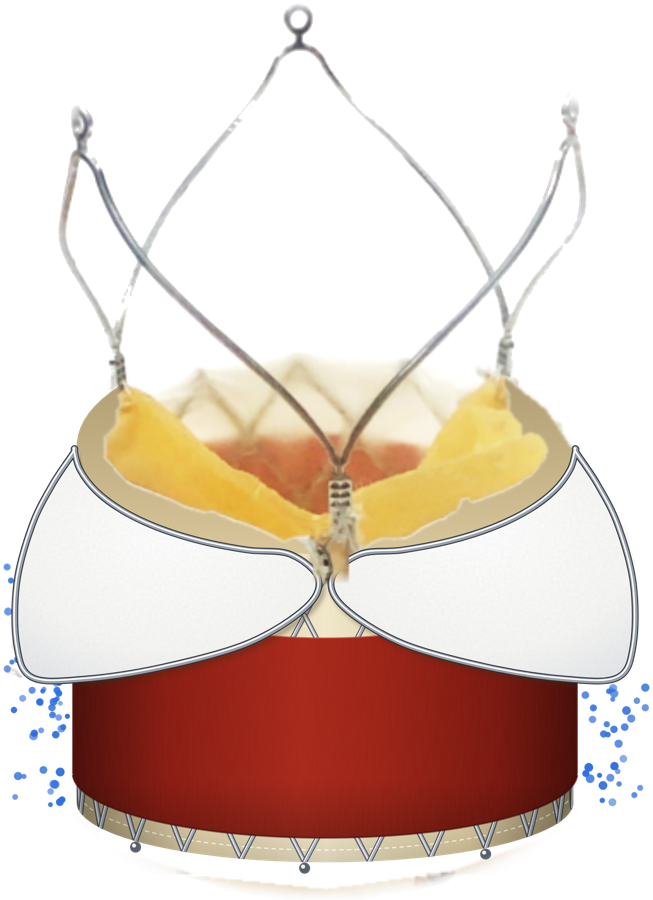
Designed for infective endocarditis: the same platform with a bioabsorbable drug-eluting skirt.
devie's grippers are designed to engage the native aortic leaflets. As the self-expanding frame expands, the leaflets are secured between the grippers and the stent frame.
Dry pericardial leaflets come pre-loaded on the delivery system: no rinsing, no loading in the cath lab, and a lower target delivery profile.
Securing the infected leaflets between grippers and frame aims to immobilize bacterial vegetations and is designed to prevent embolism.
Bioabsorbable antibiotic films are designed to release high-dose antibiotics directly into the infection, penetrating the biofilm, to increase local drug exposure and complement systemic therapy.
We welcome conversations with strategic partners, investors and clinicians. Bench and preclinical data and the full IP position are available under NDA.